
Creatine works. But most people dose it wrong,
explain it wrong, and coach it wrong.
The Complete Creatine Manual
A science-based guide to dosing, safety, performance, and brain health
Mike T. Nelson, PhD · MSME · CSCS · CISSN

Every coach knows creatine works. Few understand why.
Fewer still know who it works best for — what dose actually matters for brain health vs. bone health vs. performance, which “better forms” are marketing fiction, and why some athletes respond dramatically while others feel nothing.
You can find thousands of articles about creatine online.
Most of them are incomplete, outdated, written to sell supplements, missing clinical context, or just wrong.
This manual puts everything in one place.
The actual data. Explained clearly. Applied to real coaching.
Built on the research. Featuring the researchers.
This manual draws directly on conversations with three of the world’s most published creatine scientists. These are their words, not paraphrases:
"The entire body of evidence suggests it's probably the most safest, effective ergogenic aid that we can now take. And the potential downside is — what? I can't find one."
— Dr. Darren Candow University of Regina | Led 2-year bone RCT in 260+ postmenopausal women
"I think 10 grams a day checks all the boxes from bone, brain and muscle. If I personally take at least 10 grams a day, that definitely checks the box for muscle, bone, and hopefully the brain."
— Dr. Darren Candow University of Regina
"Nine of those twelve studies have shown a significant increase [in brain creatine]. Different countries, different populations — nine of twelve is quite significant to me."
— Dr. Eric Rawson Bloomsburg University | Pioneer of brain creatine research via MRS
"You'd have to eat about three pounds of beef to get about five grams of creatine — about two and a half pounds of salmon. Those are maybe the three best food sources out there. And obviously that's not a sustainable recommendation."
— Dr. Scott Forbes Brandon University | One of the most prolific creatine researchers in North America
What's inside
The fundamentals — done right
What creatine actually does at the cellular level (and what it cannot do)
Loading vs. no loading — which protocol actually fits your athlete
Why 5g/day works for most people… but not all
The real reason some people don’t respond — and how to identify them before you blame the supplement
Why vegetarians and vegans are often your highest-responders — and why that tells you something important about how creatine actually works
Dosing by goal
Standard performance dosing vs. higher dosing for brain, bone, and aging
The dosing mistake even experienced coaches make with masters athletes — and why it costs their clients results
When loading is useful — and when it’s pointless
How to take creatine with caffeine without worrying about interference
Why endurance athletes get different results than strength athletes — and how to set expectations accordingly
The deeper science
Brain creatine research: what MRS studies actually show (and the human vs. animal gap that changes everything)
Why contact sport athletes may benefit from creatine for reasons beyond muscle
Bone geometry vs. bone mineral density — and why the distinction matters more than most coaches realize
What the sleep deprivation studies show about creatine and cognitive function
Why creatine might matter more for aging than for performance — and what that means for your masters clients right now
Myth demolition
What the data actually says about kidney damage (not what you’ve heard)
The hair loss study everyone misquotes — what it actually showed, and what the follow-up found
Dehydration and cramping: the evidence is the opposite of the myth
Why most “better forms” of creatine are marketing, not science — with the head-to-head data
The longest safety studies in humans: what 14 years of continuous high-dose use actually shows
Applied coaching
How to explain creatine to clients without sounding like a supplement ad
The difference between statistically significant and actually useful — and why it matters for setting client expectations
Protocols for strength athletes, endurance athletes, masters athletes, contact sports, and clinical populations
Client-facing worksheets for goal selection and response tracking
What this manual is NOT
This manual does not:
Try to sell you creatine
Repeat internet myths or certification-course oversimplifications
Cherry-pick studies to support a predetermined conclusion
Make performance promises
Dumb down the research to make it more palatable

Who this is for
This manual makes the most sense if you are:
A strength coach or personal trainer who wants correct, defensible protocols
An athlete who cares about evidence more than marketing
A clinician who wants actual references to discuss with patients
Someone over 40 who wants to use creatine intelligently — for muscle, bone, and brain
Anyone tired of searching PubMed for hours and still not knowing what to recommend

Who wrote this
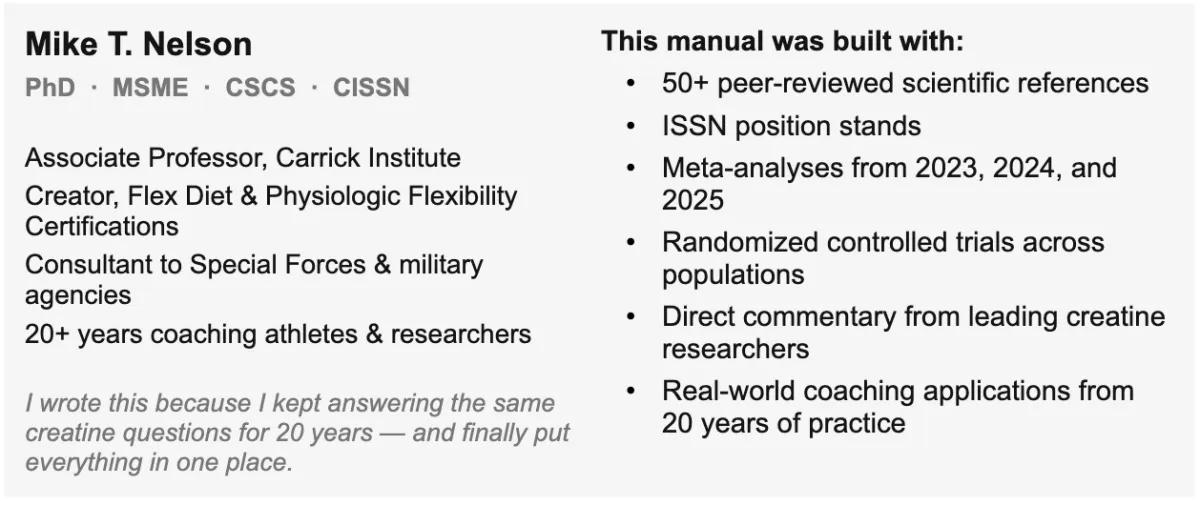
Why this costs $37
The studies in this manual took researchers decades to design, fund, and run. The most recent meta-analyses were published in 2023, 2024, and 2025. Most certification materials don't have them yet.
Reading and synthesizing 50+ peer-reviewed papers yourself — at a conservative estimate — takes 40-60 hours.
Being qualified to interpret them takes longer.
Most people will never read these papers. Most certification courses don't cover them. This manual does.
You get all of it synthesized, cited, and applied for less than a month’s supply of creatine monohydrate.
Everything included

30-Day Money-Back Guarantee
If you read this manual and don't feel it was worth the price, email me within 30 days and I'l refund you in full.
No forms. No explanations. No hassle.
I'm not worried about that policy. The research is solid. The applications are real. The manual delivers.
Frequently asked questions
Isn't most of this available for free online?
Fragments of it are. The problem is that creatine information online is scattered across thousands of sources, most of which are written to sell supplements, are 10+ years out of date, or stop at "it helps with strength." This manual synthesizes 50+ peer-reviewed papers-including meta-analyses from 2023-25-with direct commentary from the researchers who ran the studies. The synthesis is the work.
I already know creatine works. What else is there to learn?
Most coaches know creatine improves strength and power. Far fewer know: why some athletes are non-responders and how to identify them in advance, why the standard 5g/day dose is probably wrong for brain and bone applications, how to combine creatine with caffeine without second-guessing yourself, or what the data actually says about creatine in aging, contact sport, and sleep deprivation. That's most of the manual.
Does this cover female clients, masters athletes, and endurance athletes?
Yes— each population gets its own dedicated section. The evidence base is different across groups, and the dosing and rationale differ accordingly. The bone and brain sections are especially relevant for post-menopausal women and masters athletes, where the data is newer and most coaches haven't seen it yet.
I've heard creatine and caffeine cancel each other out. Is that true?
This is one of the most common misconceptions in the field. The research behind it is largely outdated and based on a single flawed study design. The manual covers this in a dedicated creatine + caffeine section with current evidence, so you can give clients a clear answer instead of a hedge.
Is this updated with recent research or is it based on older studies?
The reference list includes meta-analyses and RCTs published through 2025. The brain and bone sections draw on research from 2020-2025 specifically because that's where the field has moved fastest. Older foundational research is included where it's still the best available evidence, but nothing in this manual is decade-old material dressed up as current.
What about creatine form - should I be using HCl, buffered, or something else?
The manual covers this directly with head-to-head comparison data. The short answer: creatine monohydrate outperforms or equals every alternative form in virtually every study that's compared them, and the alternatives cost significantly more. The manual gives you the data so you can confidently tell clients exactly what to buy—and why.
What if I'm not satisfied?
30-day full refund, no questions asked. See the guarantee above.
If you use creatine, coach people who use creatine, or plan to recommend it —
you will use this manual more than once.
© 2026 Extreme Human Performance LLC • miketnelson.com/physiologic-flexibility-certification